Attorneys, Counselors & Barristers

U.S. Immigration Law Practice
Pakistan- United States Collaborative Law Litigation Practice

United States Department of Homeland Security | Embassy & Bureau of Consular Affairs Practice, Pakistan.
United States & Pakistan (Cross-Border Litigation Practice)

The Law Office assists clients (from the Pakistan and Saudi Arabia jurisdictions) in United States non-immigrant visas (B1/B2, F1, E1, E2, L1A, J1, I, SB1, C1, J1/J2, M1 visas and other consular post/embassy matters), including previously refused, complex, and difficult visa cases. Provide comprehensive U.S.A. (visas) legal representation across Pakistan.


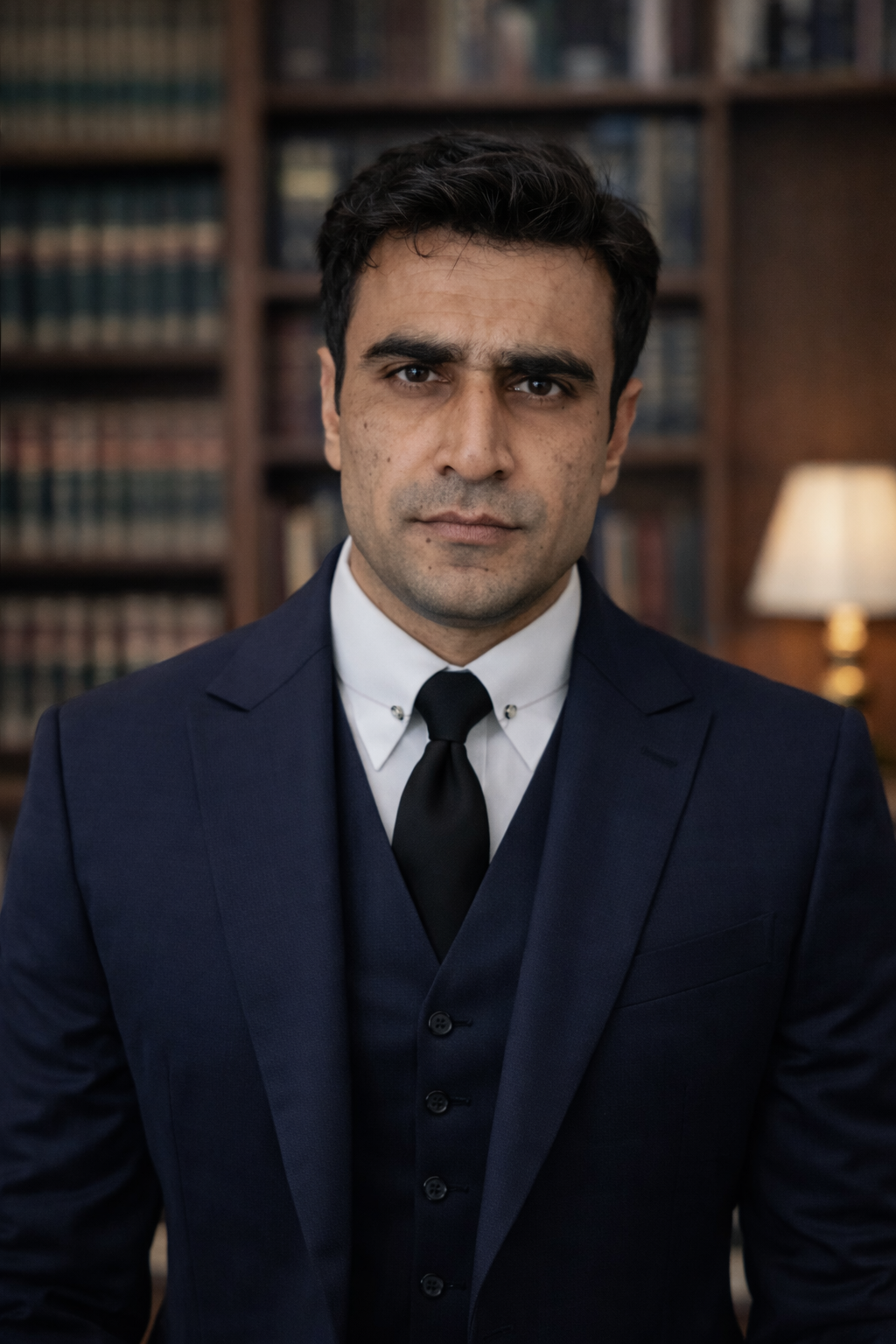
Mr. Hamad Ali Dogar (Attorney at Law) attended Pace University School of Law in New York (LLM program) and Practice law in Pakistan. He has extensive experience working with prominent U.S.-based law firms, including Manrique Law Group New York, AK LAW California, Indus Law, and The S Team, and has collaborated with various international law offices in the United States. His expertise spans U.S. immigration and non-immigration consular post, B1/B2, F1, M, I, P, L1, E1, E2, J1, and limited EB2 (NIW-RFE), Blockchain & Crypto-Currency Laws, Cross-Border Contracts, collaborative legal counseling, and analysis of complex international disputes involving multiple jurisdictions.


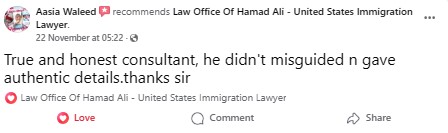
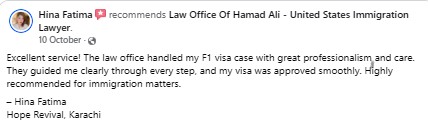
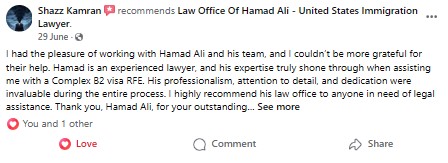
TESTIMONIALS


Our office assists in cross-border legal matters arising from the homicide or murder of U.S. citizens on foreign soil in Pakistan, including complaint strategy, jurisdiction analysis, evidence coordination, private-complainant support, and legal review of parallel issues under Pakistani and United States law. We help families and interested parties assess remedies under the Pakistan Penal Code, the Code of Criminal Procedure, and other applicable Pakistani criminal and procedural laws, while also evaluating related U.S. legal implications where the victim is a U.S. national, including cross-border reporting, coordination with U.S. authorities, preservation of evidence, witness issues, post-burial complications, and connected civil, immigration, probate, or wrongful-death consequences. Our services include factual analysis, complaint preparation, record organization, legal theory development, and support in matters involving transnational crime, foreign-soil death investigations, and related federal, state, and Pakistani law issues

Cross-border negligence, wrongful-death, probate, estate, succession, and inheritance matters under both United States and Pakistani law, including legal analysis of jurisdiction, applicable law, estate rights, heirship, beneficiary claims, probate strategy, and civil recovery arising from death-related disputes with connections to Pakistan and the United States. We advise on the Pakistani side under the Succession Act, 1925, the Specific Relief Act, 1877, the Code of Civil Procedure, 1908, and other applicable inheritance, estate, and civil-remedy laws, and on the United States side under applicable state wrongful-death, probate, and intestacy statutes, including laws such as New York Estates, Powers and Trusts Law § 5-4.1 for wrongful death and § 4-1.1 for descent and distribution, as well as comparable probate and heirship provisions under the Texas Estates Code, including Chapters 201, 202, and 256. We help clients evaluate whether claims should proceed under negligence, wrongful death, probate, inheritance, heirship, estate administration, or related civil-recovery theories, depending on the governing facts, the location of assets, the domicile of the decedent, the place of death, and the interaction between Pakistani and United States law
We assist clients in Pakistan–United States cross-border disputes, complaints, and compliance matters involving immigration fraud, commercial and trade violations, identity theft, cyber crimes, money laundering, customs issues, and related federal and state law exposure on both sides of the transaction. We help evaluate facts, preserve records, prepare complaint narratives, organize evidence, and coordinate civil, regulatory, and criminal referral strategy involving agencies such as the Federal Investigation Agency (FIA) in Pakistan, the Federal Bureau of Investigation (FBI), U.S. Customs and Border Protection (CBP), and, where immigration-benefit fraud is involved, the U.S. Citizenship and Immigration Services (USCIS) fraud-reporting process. USCIS maintains formal fraud-reporting channels for suspected immigration fraud; the U.S. Department of Justice identifies identity theft and identity fraud as crimes involving the wrongful use of another person’s data through fraud or deception; and FinCEN administers the Bank Secrecy Act framework, which is a core U.S. anti-money-laundering regime used to detect suspicious financial activity.
On the Pakistani side, our work may involve legal analysis and complaint support under the Prevention of Electronic Crimes Act, 2016, the Anti-Money Laundering Act, 2010, and other applicable criminal, commercial, and procedural laws, including matters reported through FIA complaint channels for cybercrime, immigration, anti-money-laundering, and overseas-Pakistani complaints. On the U.S. side, our services may include analysis of exposure under federal and state laws relating to customs, unfair or deceptive trade practices, false statements, financial misconduct, electronic fraud, and commercial misrepresentation, especially where cross-border conduct affects importation, contract performance, payment flows, identity misuse, or regulatory compliance
CROSS-BORDER DIVORCE (NEW YORK–PAKISTAN) AND RELATED FAMILY LAW MATTERS
Our office assists clients in New York–Pakistan cross-border divorce and family-law matters involving jurisdiction analysis, recognition of foreign marriage and divorce issues, talaq, khula, judicial divorce, annulment, service and notice issues, child custody and visitation disputes, spousal maintenance, child support, marital property questions, and enforcement strategy under both Pakistani and New York law. On the Pakistani side, we advise under the Muslim Family Laws Ordinance, 1961, the Dissolution of Muslim Marriages Act, 1939, the Family Courts Act, 1964, and related personal-status and procedural laws governing divorce, notice, dower, maintenance, custody, and family-rights enforcement. On the New York side, we advise under the New York Domestic Relations Law, including Domestic Relations Law § 170 governing divorce, Domestic Relations Law § 236 governing equitable distribution and maintenance, Domestic Relations Law § 240 governing custody, visitation, and child support, and Domestic Relations Law Article 9, including § 140, governing annulment, together with the New York Family Court Act, including § 115 and § 651, where custody, visitation, support, paternity, or related family-court proceedings arise. Our services include legal analysis of foreign-divorce recognition, competing proceedings in New York and Pakistan, notice compliance, custody and visitation violations, financial claims, marital-rights disputes, and cross-border family-law strategy where matrimonial disputes affect both jurisdictions.

Lahore & Multan Bench (High Court)


At our law office, we are committed to serving the community by providing free legal assistance to those in need. We specifically help individuals facing litigation in the High Court, focusing exclusively on writ petitions and bail matters. Our services are available at both the Divisional benches, where we strive to ensure that justice is accessible to everyone. We aim to make justice more accessible for those who truly need it. If you or someone you know is in urgent need of legal support in these areas, we are here to help. Contact Human Rights Field Office For Multan High Court Bench: WhatsApp +923347107574. (Limited & Specific Cases subject to terms & conditions reserved by Law Office).


ICE News and update For F1, M, J1 (International Students)
Search  (SEVP)-certified schools
© Indus Pacific Law Office of Hamad Ali